

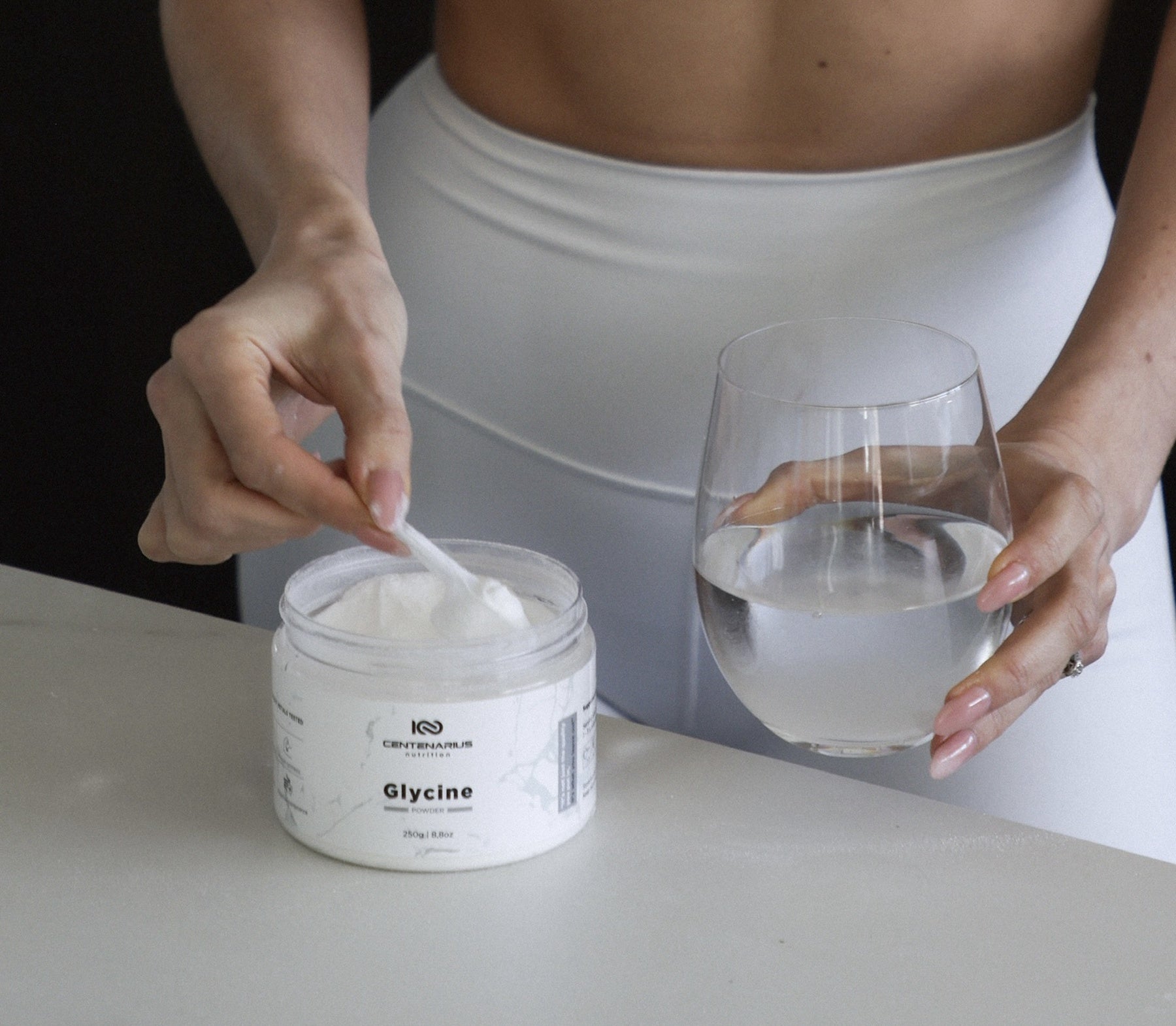
Poor sleep. Slower recovery. Brain fog. Premature aging.
Many people spend years searching for solutions without realizing they may simply be lacking enough of one of the body’s most fundamental amino acids: glycine.
Glycine is not a trending supplement or a new discovery. It is one of the most widely studied amino acids in human health research. Yet modern diets may provide less glycine than what some researchers believe could be optimal for long-term health, recovery and healthy aging.
Some researchers believe lower glycine intake may contribute to many of the issues listed above.
Here is what the science actually shows.
Table of Contents
- What Is Glycine?
- Glycine for Sleep: How It Supports Deep Rest and Recovery
- Glycine for Gut Health: Supporting Your Intestinal Barrier
- Glycine for Skin: Collagen, Elasticity and Aging
- Glycine and Longevity: What Preclinical and Mechanistic Research Suggests
- Glycine and Glutathione: Your Body’s Master Antioxidant
- Glycine Powder: How to Take It and What to Look For
- Glycine Dosage Guide
- Frequently Asked Questions
- The Bottom Line
- Sources
1. What Is Glycine?
Glycine is classified as a non-essential amino acid, meaning your body can synthesize it from other compounds. However, non-essential does not mean unimportant.
Your liver produces about 3 grams of glycine daily, but research suggests total daily needs may be significantly higher, especially during periods of stress, poor sleep, aging or intense exercise.
That gap may matter. Traditional diets rich in collagen-containing foods like bone broth, organ meats and slow-cooked proteins provided far more glycine than most people consume today. Modern eating patterns may have contributed to lower glycine intake across much of the population.
Glycine is also a building block for several critical compounds including collagen, glutathione and creatine. Without adequate glycine, these important biological processes may become less efficient over time.
2. Glycine for Sleep: How It Supports Deep Rest and Recovery
This is the most clinically studied benefit of glycine supplementation.
Multiple controlled human trials suggest that taking glycine before bed may significantly improve subjective sleep quality.
Clinical studies demonstrate that 3 grams of glycine taken before bedtime may:
- improve sleep quality
- reduce sleep latency
- improve next-day alertness
- support deeper restorative sleep
Unlike many conventional sleep aids, glycine appears to preserve natural sleep architecture while supporting better subjective sleep satisfaction.
A controlled clinical trial using objective polysomnographic recordings found that participants taking 3 grams of glycine before bedtime reported feeling more refreshed upon waking, experienced faster sleep onset and showed improved sleep efficiency on objective measurements.
What makes glycine before bed particularly interesting is its mechanism.
Research suggests glycine may help support a reduction in core body temperature associated with sleep onset. Since the body naturally lowers core temperature before sleep, glycine appears to support a process already built into human physiology.
In simple terms, glycine before bed helps the body transition naturally into sleep. No next-day grogginess. No dependency. No sedative effect.
Many people also report that taking glycine before bed helps reduce restlessness and racing thoughts before sleep, consistent with glycine’s role as an inhibitory neurotransmitter involved in calming neural activity.
3. Glycine for Gut Health: Supporting Your Intestinal Barrier
Glycine plays a meaningful structural role in maintaining gut barrier integrity.
The intestinal lining relies on tightly connected cells known as “tight junctions” to help regulate what enters the bloodstream. When this barrier becomes compromised, digestive discomfort and systemic inflammation may increase.
Research examining amino acid supplementation and intestinal permeability has consistently identified glycine as one of the key amino acids involved in supporting barrier function.
Its anti-inflammatory properties within the gastrointestinal tract make glycine particularly relevant for individuals experiencing:
- bloating
- digestive sensitivity
- gut-related inflammation
- recovery from digestive stress
For gut health, consistency appears more important than timing. Most protocols use 3g to 5g daily over several weeks.
4. Glycine for Skin: Collagen, Elasticity and Aging
Glycine is the primary structural amino acid in collagen, accounting for approximately one-third of its total composition.
In the collagen triple helix, every third residue is glycine, a pattern critical for proper collagen formation and structural integrity.
Without sufficient glycine, the body may struggle to efficiently produce and repair collagen regardless of collagen intake itself.
This may influence:
- skin elasticity
- connective tissue repair
- visible signs of aging
- joint support
- exercise recovery
A clinical observational trial published in npj Aging found that supplementation with collagen amino acids was associated with measurable improvements in skin-related aging markers and reductions in biological age measurements over time.
Glycine benefits for women are especially relevant in skin and collagen research, as collagen production naturally declines more rapidly after hormonal changes in midlife.
5. Glycine and Longevity: What Preclinical and Mechanistic Research Suggests
This is where glycine research is advancing most rapidly.
While much of the longevity evidence remains preclinical and mechanistic, the findings emerging across multiple independent research groups are increasingly compelling.
Research suggests glycine may support pathways associated with healthy aging including:
- glutathione synthesis
- mitochondrial function
- autophagy
- collagen maintenance
- inflammatory balance
- metabolic health
Research published on PubMed has explored glycine’s relationship with methionine balance and cellular repair pathways involved in longevity science.
Animal studies have demonstrated lifespan-supporting effects, while observational human data has linked higher glycine levels with more favorable aging markers.
After age 30, natural glycine production may begin declining while demand for this amino acid may increase due to oxidative stress, sleep disruption and modern dietary patterns.
This makes glycine increasingly relevant within longevity-focused wellness routines.
6. Glycine and Glutathione: Your Body’s Master Antioxidant
Glycine is one of the three amino acids required for the body’s production of glutathione, often referred to as the body’s “master antioxidant.”
Glutathione helps protect cells from oxidative stress and supports:
- detoxification
- mitochondrial health
- immune function
- cellular resilience
As the body ages, natural glutathione production may decline.
Research from Baylor College of Medicine found that supplementing older adults with glycine and N-acetylcysteine helped restore glutathione levels comparable to younger adults. When supplementation stopped, levels declined again within several weeks.
Supporting glutathione production through adequate glycine intake is increasingly viewed as one of the foundational strategies for long-term cellular resilience.
7. Glycine Powder: How to Take It and What to Look For
Glycine powder is the most practical and versatile form of supplementation.
It dissolves easily in:
- water
- coffee
- tea
- smoothies
- matcha
and has a naturally mild, slightly sweet taste that does not significantly alter flavor.
Many people find that adding glycine powder to coffee or taking it before bed in warm water is the easiest and most sustainable daily habit.
When choosing a glycine supplement, quality matters.
Pharmaceutical-Grade Purity
The standard commonly used in clinical research.
Single Ingredient Formula
No fillers, anti-caking agents or unnecessary additives.
Transparent Sourcing
Japan is widely recognized for exceptionally high manufacturing standards in pharmaceutical-grade amino acids.
Third-Party Testing
Independent testing helps verify purity, heavy metal screening and label accuracy.
8. Glycine Dosage Guide
Most clinical research on glycine uses a daily intake of approximately 3 grams, particularly in studies examining sleep quality and nervous system support. For sleep benefits specifically, taking glycine before bed 30 to 60 minutes prior to sleep is the timing used in most clinical trials.
For broader wellness goals such as collagen production, gut support and healthy aging, many practitioners recommend between 3g and 5g daily. For these purposes, timing appears less important than consistency.
Unlike some supplements, glycine does not require a loading phase. Benefits appear to build gradually with consistent daily use over time.
9. Frequently Asked Questions
Is glycine safe to take every day?
Yes. Glycine has an excellent safety profile and is generally well tolerated at doses of 3g to 18g daily.
How much glycine should I take before bed?
Most clinical sleep studies use 3 grams taken approximately 30 to 60 minutes before sleep.
Does glycine help with anxiety?
Glycine functions as an inhibitory neurotransmitter and may help support relaxation and nervous system calmness.
Can glycine improve skin health?
Yes. Glycine is the most abundant amino acid in collagen and plays an essential role in collagen synthesis and connective tissue repair.
Is glycine better than melatonin for sleep?
They work differently. Melatonin signals sleep timing, while glycine appears to support natural sleep physiology through temperature regulation and nervous system effects.
Can you take glycine with magnesium?
Yes. Glycine and magnesium are commonly combined as part of nighttime wellness and sleep-support routines.
Does glycine break a fast?
Technically yes, as glycine contains calories. However, a standard 3g serving contains very few calories and may not meaningfully impact many fasting protocols.
What are the side effects of glycine?
Side effects at standard doses are uncommon. Mild digestive discomfort has occasionally been reported at significantly higher doses.
10. The Bottom Line
In a world dominated by overstimulation, poor sleep and highly processed modern diets, glycine represents something refreshingly simple: foundational support for how the body is designed to function.
The evidence surrounding glycine’s role in sleep quality, gut health, collagen synthesis, antioxidant production and healthy aging continues to grow rapidly.
Whether you are focused on recovery, longevity, better sleep or overall resilience, glycine is one of the simplest evidence-informed additions to a daily wellness routine.
Looking for a pharmaceutical-grade glycine powder?
Sourced from Japan. Independently third-party tested. Nothing added but pure glycine.
These statements have not been evaluated by the Food and Drug Administration. This product is not intended to diagnose, treat, cure or prevent any disease.
11. Sources
- Bannai M, Kawai N. Glycine improves the quality of sleep. Journal of Pharmacological Sciences. 2012.
- Bannai M, et al. The effects of glycine on subjective daytime performance in sleep-restricted volunteers. Frontiers in Neurology. 2012.
- Yamadera W, et al. Glycine ingestion improves subjective sleep quality in human volunteers. Sleep and Biological Rhythms. 2007.
- Cutter JL, et al. Glycine and aging: Evidence and mechanisms. 2023.
- Jafari M, et al. A collagen amino acid composition supplementation reduces biological age in humans. npj Aging.2025.
- Razak MA, et al. Multifarious beneficial effect of nonessential amino acid, glycine: a review. Oxidative Medicine and Cellular Longevity. 2017.
- Baylor College of Medicine research on glycine, NAC and glutathione restoration in older adults.
- Sleep Foundation: Glycine for Sleep
- WebMD: Health Benefits of Glycine


