

Muscle loss is one of the biggest worries for people on GLP-1 medications like Ozempic, Wegovy, Mounjaro and Zepbound. The good news: it's often smaller than headlines suggest, and the right nutrition and training can make a real difference. Here's what body scans actually show, and the three steps I recommend.
Do you lose muscle on a GLP-1? The short answer: some, yes, but less than many people fear. In DEXA body-scan studies, roughly a quarter to two-fifths of the weight lost was "lean mass," which includes water, organs and a shrinking fatty liver, not only muscle. The three best-supported ways to protect muscle are enough protein, strength training two to three times a week, and creatine alongside training.
Key takeaways
- In the tirzepatide (Zepbound) trial, about 75% of weight lost was fat and 25% lean mass, the same mix as with ordinary weight loss on placebo.
- "Lean mass" on a DEXA scan isn't only muscle: it also includes water, organs and liver.
- Experts recommend protein and strength training as the core strategy during GLP-1 therapy.
- In older adults, creatine plus strength training added about 1.4 kg (3 lb) more lean tissue than training alone.
- A common protein target is 1.2 to 1.6 g per kg (0.55 to 0.73 g per lb) of body weight a day.
What does "lean mass" on a DEXA scan actually include?
A DEXA scan sorts your body into three parts: fat, bone and everything else. "Everything else" is called lean mass, and it includes much more than muscle:
- Skeletal muscle: the part you care about
- Water: inside and outside cells Organs: liver, heart, kidneys, gut
- Connective tissue: tendons, skin
- Glycogen: stored carbohydrate, which holds water with it
During weight loss, a fatty liver gets smaller, and eating less drains glycogen and the water bound to it. Both lower lean mass without touching muscle. So a scan showing "lean mass -3 kg (-6.6 lb)" is real, but it doesn't mean 3 kg of muscle is gone.
What do the GLP-1 trials show?
Lean mass falls on GLP-1 medications, but fat falls much faster.
| Study | Who | How long | Weight change | Share of weight lost as lean mass |
|---|---|---|---|---|
| STEP 1 (semaglutide, Wegovy) | 140 adults | 68 weeks | -15% | About 40%, by estimates from the study data |
| SURMOUNT-1 (tirzepatide, Zepbound) | 160 adults | 72 weeks | -21% | About 25%, the same as placebo |
| Batsis 2026 review | 35 trials | Median 26 weeks | Varied | Median about 29% in DEXA or body-composition studies |
In SURMOUNT-1, people on tirzepatide and people on placebo lost the same mix: about three-quarters fat and one-quarter lean mass (Look 2025). A 2026 review of 35 trials found a median lean share of about 29%, but notably, none of the trials measured physical function, such as walking speed or getting up from a chair (Batsis 2026).
A 2026 study added encouraging news. In mice, GLP-1 drugs shrank the liver more than muscle, and in a small trial in people, GLP-1 medications improved body composition without reducing strength (Langer 2026).
Why protecting muscle matters even more after 50
From middle age on, we slowly lose muscle and strength even without dieting, so extra loss can matter more for balance, energy and independence. A 2026 review found that most GLP-1 studies show some drop in muscle mass, usually without a significant change in strength, and that muscle quality often improves as fat inside the muscle drops. But only 4 of its 21 studies looked at older adults specifically (Jagasia 2026). That's exactly why I recommend acting now, rather than waiting for perfect evidence.
Step 1: Get enough protein
A common starting target during active weight loss is 1.2 to 1.6 g of protein per kg of body weight a day (0.55 to 0.73 g per lb), or a simpler 80 to 120 g a day. A 2025 joint advisory from four US obesity and nutrition societies lists these targets and makes protecting muscle a priority during GLP-1 therapy (Mozaffarian 2025).
Example: at 170 lb (77 kg), 1.2 to 1.6 g/kg comes to about 93 to 124 g of protein a day, or four to five servings of 20 to 30 g.
With a smaller appetite, this is the hardest part. What works in my practice:
- Spread protein out: 20 to 30 g per meal or mini-meal, rather than one big serving.
- Eat protein first, while you still have an appetite.
- Use a protein shake when solid food feels like too much. It's the easiest small-volume way to add 20 to 30 g.
More ideas in Protein on a GLP-1 When You Can't Eat Much.
Step 2: Lift weights
Strength training is the signal that tells your body to keep muscle. The 2025 joint advisory pairs protein with resistance training as the core approach during GLP-1 therapy (Mozaffarian 2025).
A simple starting week:
- Two to three sessions a week, on non-consecutive days
- All major muscle groups: legs (squats or leg press), hips (bridges or hip hinges), back (rows), chest (push-ups or chest press), shoulders and core
- Progress slowly: add a rep, a set or a little weight when the last reps feel easy
- Walk on the other days if you can
If you're new to lifting, a few sessions with a trainer can help with form.
Step 3: Add creatine
Creatine helps your muscles produce quick energy, so you can get a little more out of every workout. It hasn't been tested in GLP-1 users yet, but in older adults the evidence is strong:
- A meta-analysis of 22 trials in 721 older adults found that creatine plus strength training added about 1.4 kg (3 lb) more lean tissue, along with greater chest and leg strength, than training alone (Chilibeck 2017).
- An updated 2021 meta-analysis reached the same conclusion (Forbes 2021).
The benefits come with training, so pair creatine with lifting. One thing to know: creatine draws water into your muscles, so the scale may move a little slower in the first weeks. That's water in muscle, not fat.
How long until it works?
- Strength: most people notice gains within 4 to 8 weeks of regular training.
- Protein target: build up over 1 to 2 weeks if your appetite is low.
- Creatine: at 3 to 5 g a day, muscle stores fill over about 3 to 4 weeks.
What I Recommend, Based on My Practice and the Research
I believe quality matters. I always choose clean ingredients of the highest quality, especially when your appetite is small and every serving counts. That's why I recommend these to my clients on GLP-1s:
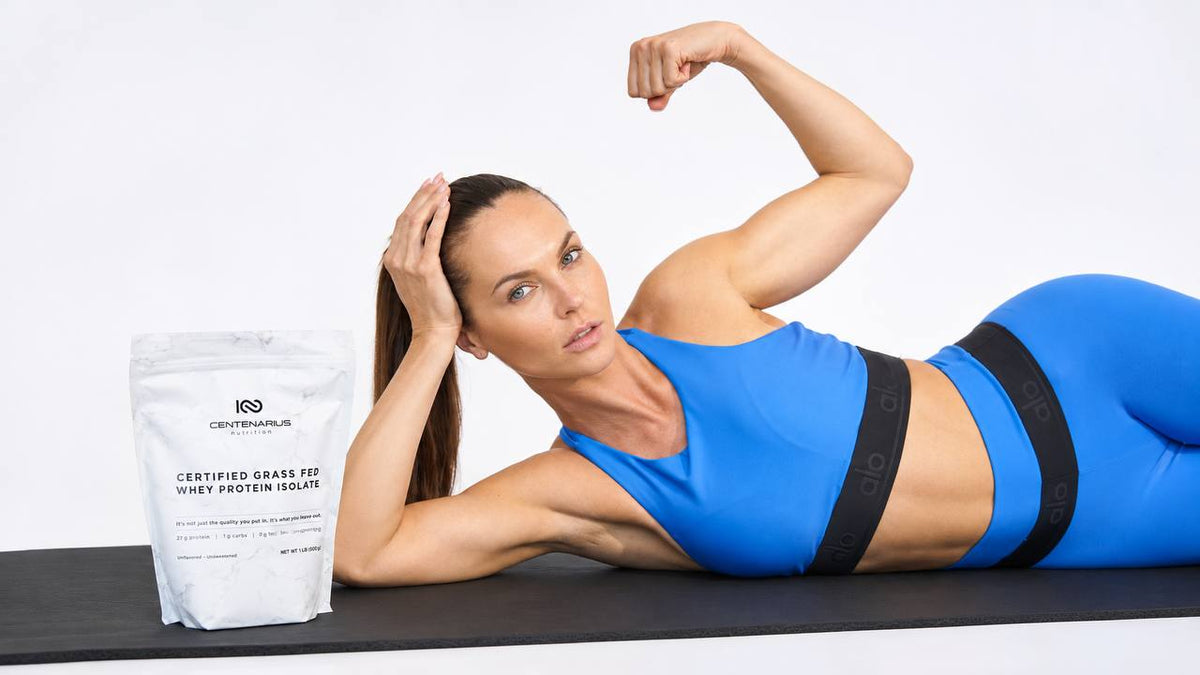
- Centenarius Grass-Fed Whey Protein Isolate: 27 g of complete protein per serving from Truly Grass Fed® Irish whey, with 2.77 g of leucine, the amino acid that signals muscle building. It's unflavored, gentle and easy to digest, which matters when your stomach feels sensitive on a GLP-1.
- Centenarius Creapure® Creatine Monohydrate: 99.9% pure creatine made in Germany, 5 g per serving, single ingredient.
Both are 3rd-party independently tested for heavy metals and purity. For an easy way to get both, see the Centenarius GLP-1 Optimizer Bundle.
Before you start
If you take any medication, are pregnant or breastfeeding, or have a health condition such as kidney disease, talk to your doctor before starting a supplement. If you feel weak or unsteady, or notice any side effects, contact your doctor.
Questions I'm often asked
How much muscle do you lose on Ozempic or Zepbound? In DEXA studies, roughly 25 to 40% of the weight lost was lean mass. Lean mass isn't only muscle: it also includes water, organs and liver.
Is the lean mass I lose on a GLP-1 really muscle? Only partly. DEXA lean mass counts everything that isn't fat or bone, including water, glycogen and a shrinking fatty liver, so it overstates true muscle loss.
Can you build muscle on a GLP-1? Some people hold or even gain muscle with consistent strength training and enough protein. For most people, the realistic goal is to keep losses small.
Should I take creatine on a GLP-1? Creatine hasn't been tested in GLP-1 users yet, but in older adults who strength train, it supports muscle and strength.* If you take any medication, ask your doctor first.
Will creatine stop the scale from moving? It can add a little water weight in the first weeks, stored in muscle, not fat. The scale usually settles after that.
How often should I lift weights on a GLP-1? Aim for two to three strength sessions a week on non-consecutive days, covering all major muscle groups.
References
- Wilding JPH, et al. Once-weekly semaglutide in adults with overweight or obesity (STEP 1). N Engl J Med. 2021;384:989-1002. doi:10.1056/NEJMoa2032183
- Look M, et al. Body composition changes during weight reduction with tirzepatide in the SURMOUNT-1 study of adults with obesity or overweight. Diabetes Obes Metab. 2025;27(5):2720-2729. doi:10.1111/dom.16275
- Batsis JA, et al. Effect of incretin-based and nonpharmacologic weight loss on body composition: a systematic review. Ann Intern Med. 2026;179(7):996-1013. doi:10.7326/ANNALS-25-00478
- Langer HT, et al. Weight loss with GLP-1 medicines does not result in a disproportionate loss of muscle mass or function in obese mice and humans. Cell Rep Med. 2026;7(3):102665. doi:10.1016/j.xcrm.2026.102665
- Jagasia K, et al. GLP-1 receptor agonist therapy and skeletal muscle: a narrative review synthesizing adult evidence with implications for older adults. JAR Life. 2026;15:100083. doi:10.1016/j.jarlif.2026.100083
- Mozaffarian D, et al. Nutritional priorities to support GLP-1 therapy for obesity: a joint advisory. Am J Clin Nutr. 2025;122(1):344-367. doi:10.1016/j.ajcnut.2025.04.023
- Chilibeck PD, et al. Effect of creatine supplementation during resistance training on lean tissue mass and muscular strength in older adults: a meta-analysis. Open Access J Sports Med. 2017;8:213-226. doi:10.2147/OAJSM.S123529
- Forbes SC, et al. Meta-analysis examining the importance of creatine ingestion strategies on lean tissue mass and strength in older adults. Nutrients. 2021;13(6):1912. doi:10.3390/nu13061912


